
The Reckless Politics of Breakdown That’s Destroying America
There is a pernicious idea loose in American public life: that the only way to change the system is to make it fail.
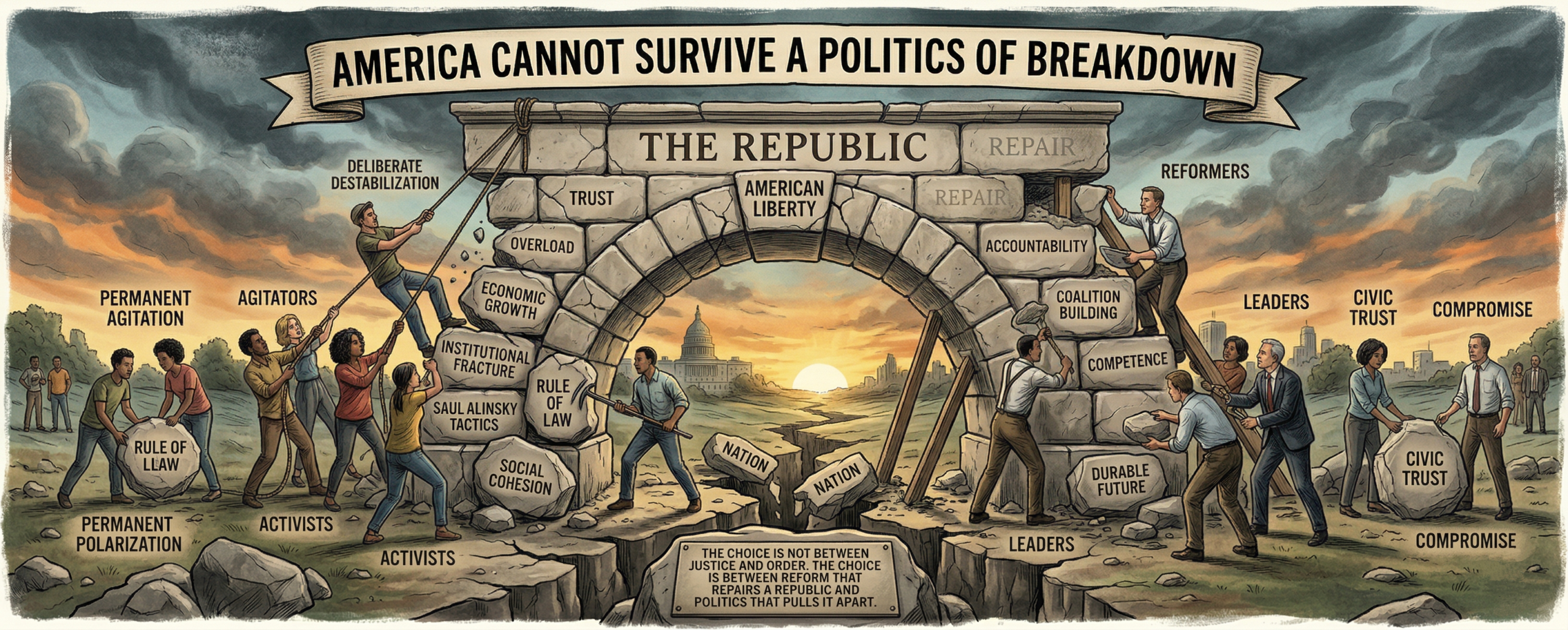
It is an idea dressed up as courage, sold as justice, and excused as necessity. But strip away the rhetoric, and what remains is a toxic politics of deliberate destabilization — a ruthless strategy that treats overload, agitation, and institutional fracture not as unfortunate side effects, but as useful weapons.
That is why the frightening combination of Saul Alinsky-style confrontation and Cloward-Piven-style crisis politics should alarm anyone who cares about the future of the country. One teaches activists how to apply relentless pressure, polarize conflict, and force opponents into defensive retreat. The other is often understood as a theory of overwhelming institutions until they buckle, creating the conditions for political transformation through engineered crisis. Put together, they do not produce healthy reform. They produce a politics of catastrophic breakdown.
And nations do not flourish under a politics of breakdown.
America is not held together by slogans or elections alone. It is held together by trust — trust that institutions can still function, that rules still matter, that public life is not merely a contest over who can create the most chaos. That trust is already perilously thin. A political model built on permanent agitation tears through what remains of it.
When every grievance must be weaponized, every system pushed toward overload, and every dispute treated as a showdown, the damage spreads far beyond politics. Economic growth suffers because investment depends on stability. Communities weaken because civic trust is replaced by corrosive suspicion. Public institutions become less competent because they are forced to spend their energy managing manufactured crises instead of solving real problems. Social cohesion erodes because citizens are trained to see one another not as fellow Americans, but as enemies to be cornered and defeated.
This is not renewal. It is corrosion.
Of course, defenders of these tactics will say that entrenched power rarely yields without pressure. They are right about one thing: pressure is often necessary. Reform does not happen by polite request alone. But there is a profound difference between pressure used to correct a system and pressure used to break it. There is a difference between democratic confrontation and strategic sabotage. There is a difference between forcing accountability and glorifying overload.
That distinction matters because a free society cannot preserve itself by normalizing methods that weaken the very institutions it depends on. Even flawed institutions perform essential functions. They uphold order, process disputes, provide services, and maintain the predictability on which ordinary people build their lives. If political actors begin to treat institutional stress as a virtue, then dysfunction stops being a warning sign and becomes a business model.
And once chaos becomes a business model, the incentives get darker fast.
Leaders are rewarded not for solving problems, but for inflaming them. Activists are rewarded not for building coalitions, but for escalating resentment. Public officials become more reactive, more bureaucratic, and less effective. Citizens grow more cynical, assuming that every crisis is staged, every conflict manipulated, and every institution corrupt beyond repair. The republic becomes weaker not in one dramatic collapse, but through steady internal exhaustion.
A country cannot build prosperity on permanent destabilization. It cannot cultivate trust while rewarding rupture. It cannot sustain self-government if too many of its political actors come to believe that social fracture is the fastest path to power.
America has real injustices, real failures, and real institutions in need of reform. But reform that depends on making society more brittle is not wisdom. It is recklessness. A politics that thrives on overload may win headlines, concessions, and moments of spectacle. What it cannot do is build a durable future.
The United States does not need less passion, less accountability, or less willingness to confront failure. It needs more leaders who know the difference between repair and ruin. It needs reformers who can challenge what is broken without setting fire to what still holds the country together.
Because once a nation starts treating breakdown as strategy, it should not be surprised when breakdown becomes its condition.
America will not be saved by those who know only how to agitate, overload, and divide. It will be saved — if it is saved at all — by those willing to rebuild trust, restore competence, and strengthen the institutions that make liberty possible.
The choice is not between justice and order.
The choice is between reform that repairs a republic and politics that pulls it apart.