
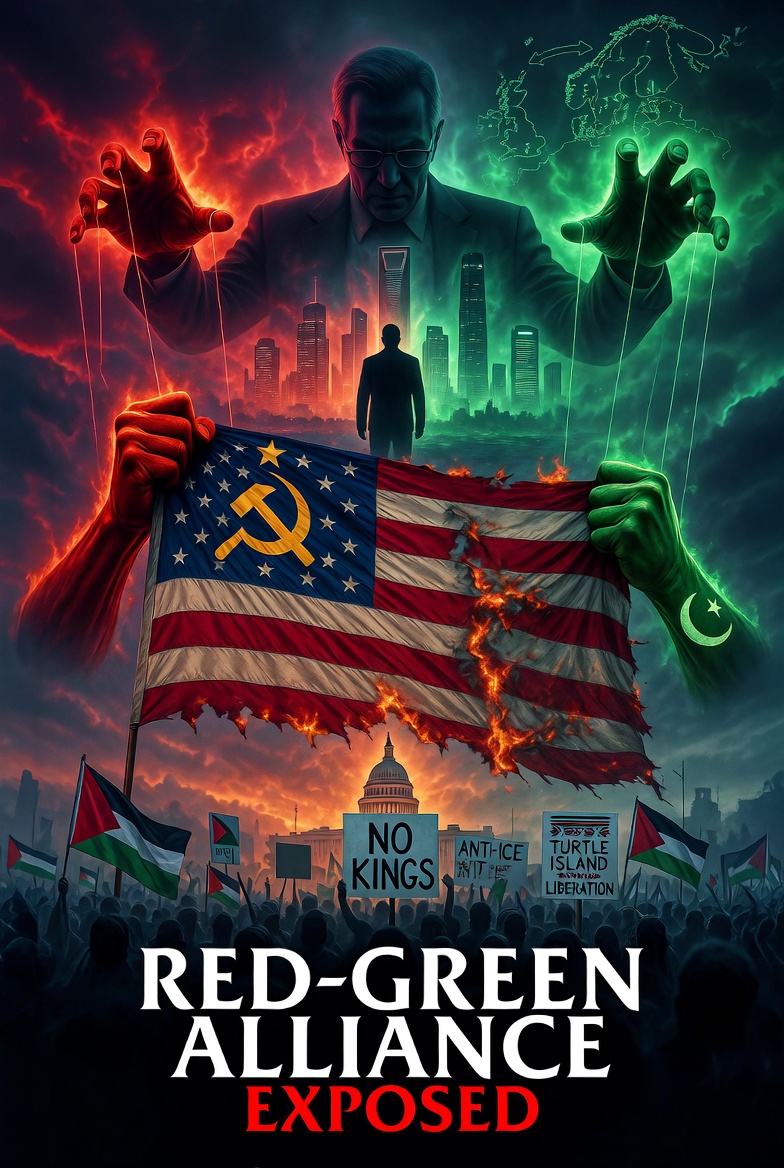
The Protest Story America Is Not Being Told
Most Americans see protests as spontaneous eruptions: a headline, a crowd, a slogan, a few dramatic arrests, and then the news cycle moves on.
But behind many of the largest demonstrations is something far more organized: a professional activist ecosystem with national toolkits, donor pipelines, legal support, media arms, nonprofit umbrellas, student chapters, union allies, and ideological partners that know how to turn outrage into a machine.
That does not mean every person holding a sign is paid. It does not mean every rally is violent. And it does not mean ordinary Americans do not have a right to protest. They do.
The deeper question is more disturbing: who builds the infrastructure, who funds it, who trains it, who amplifies it, and what long-term political project is being served when immigration protests, anti-Israel activism, Marxist organizing, and anti-American decolonial language all begin marching under the same banner?
That is where the story becomes explosive.
The Public Face: Mainstream, Polished, and Protected
The March 28, 2026, national “No Kings” day of action looked, from the outside, like a broad anti-Trump mobilization. Thousands of events were promoted across all 50 states. National groups provided event maps, toolkits, messaging, training, and online coordination. The coalition included familiar progressive names: Indivisible, MoveOn, the ACLU, Planned Parenthood, Public Citizen, AFL-CIO affiliates, and local activist chapters.
This is the respectable face of the movement: press releases, livestreams, volunteer sign-ups, branded websites, legal observers, and donation pages. It is not mysterious. It is modern nonprofit politics.
Funding moved through recognizable channels: foundation grants, unions, small-dollar donation platforms, and nonprofit advocacy networks. That matters because the lazy claim — “everyone was paid to be there” — misses the real story. The more powerful truth is that protest politics no longer needs to pay every person in the street. It only needs to build the machine that gets them there, arms them with slogans, supplies legal and media protection, and turns separate causes into one national narrative.
The Hard Edge: When Peaceful Protest Meets Revolutionary Infrastructure
Beneath the polished surface is a harder, more militant layer. Over the past two years, anti-ICE actions, pro-Palestinian encampments, street shutdowns, and clashes with police have repeatedly featured overlapping organizations, slogans, and ideological themes.
The same causes keep blending together: ICE is framed as colonial violence. Israel is framed as colonial occupation. Capitalism is framed as the operating system behind both. The United States itself is portrayed not as a flawed republic worth reforming, but as a settler project that must be dismantled.
This is where groups such as the Party for Socialism and Liberation, the ANSWER Coalition, American Muslims for Palestine, Students for Justice in Palestine, Within Our Lifetime, and smaller decolonial networks become important. They do not all play the same role. They do not all have the same theology or politics. But at major flashpoints, they often appear inside the same ecosystem: promoting the same actions, sharing language, cross-pollinating audiences, and linking unrelated issues into one anti-Western storyline.
The Red-Green Bargain
The phrase “Red-Green alliance” describes a tactical partnership between revolutionary leftist groups — the “Red” — and Islamist or Islamist-adjacent movements — the “Green.” On paper, this alliance should collapse under its own contradictions. Marxist revolutionaries claim to support secularism, sexual liberation, feminism, and LGBTQ rights. Islamist movements often come from religious and social views that conflict sharply with those values.
So why do they cooperate? Because they share a common enemy: Western liberal democracy, capitalism, American power, and Israel.
The alliance is not based on friendship. It is based on convergence. The Marxist side supplies anti-capitalist analysis, protest discipline, media messaging, and revolutionary vocabulary. The Islamist side supplies campus networks, grievance politics, religious-nationalist framing, and a global cause in Palestine. The decolonial side adds the language that ties it together: “settler colonialism,” “occupation,” “resistance,” and “liberation” from Turtle Island to Gaza.
Once those narratives merge, every issue becomes one issue. The border, Gaza, police, capitalism, indigenous land, prisons, student debt, and elections are no longer separate debates. They become evidence in a single indictment: America itself is illegitimate.
The Billionaire Question: Neville Roy Singham and the Professional Protest Pipeline
One of the most important names in this network is Neville Roy Singham, the American tech billionaire whose funding relationships have drawn scrutiny from congressional committees, watchdog groups, and investigative journalists. Singham-linked money has reportedly flowed through organizations connected to The People’s Forum, BreakThrough News, and other activist media or organizing hubs aligned with hard-left politics.
The People’s Forum is especially important because it functions less like a traditional think tank and more like an activist incubator: training, convening, messaging, livestreaming, and building community around a revolutionary worldview. People connected to that ecosystem have also overlapped with PSL and ANSWER organizing.
The key issue is not merely that a billionaire supports left-wing activism. Billionaires fund politics on every side. The issue is whether U.S.-based nonprofits, protest groups, and media operations are helping circulate narratives aligned with foreign authoritarian interests, including Chinese Communist Party messaging. Congressional probes have raised exactly that concern.
Until investigations are complete, careful language matters. But the pattern deserves sunlight: elite wealth, nonprofit status, activist training, anti-American messaging, and street-level unrest can combine into something much more powerful than a normal protest group.
The Campus Pipeline: AMP, SJP, WOL, and the Radicalization of Student Activism
College campuses have become one of the most important battlegrounds. Students for Justice in Palestine chapters, American Muslims for Palestine, and Within Our Lifetime have helped transform the Palestinian cause from a foreign-policy debate into a totalizing moral framework: oppressor versus oppressed, colonizer versus colonized, resistance versus empire.
That framework spreads quickly because it is simple, emotional, and morally absolute. Once a young activist accepts the vocabulary, nearly every institution can be reinterpreted as part of the same system: police, borders, corporations, universities, donors, Israel, and America itself.
The most serious allegations against some of these networks involve historical connections to Hamas-linked figures, the Holy Land Foundation case, and ongoing congressional or state-level investigations. Those allegations must be documented precisely. But the broader public issue is already visible: campus activism is no longer only about debate. It increasingly operates as a training ground for direct action, disruption, intimidation, and ideological sorting.
Administrators often retreat. Donors panic. Jewish students report intimidation. Peaceful students are pulled into increasingly radical language. And the most extreme organizers learn a lesson: if they cloak coercion in the language of civil rights, institutions often hesitate to enforce their own rules.
Turtle Island: The Decolonial Glue
The third layer is decolonial language. “Turtle Island” is an Indigenous term for North America, but in radical activist circles it is often used to claim that the United States is an occupying power on stolen land. From there, the argument expands: if America is occupation and Israel is occupation, then ICE, police, capitalism, and borders are all arms of the same colonial system.
This language is powerful because it turns policy disagreements into existential accusations. You are not debating immigration enforcement. You are defending genocide. You are not debating Israel policy. You are defending colonialism. You are not defending constitutional order. You are defending occupation.
A small militant fringe has allegedly taken that worldview into dangerous territory. The Turtle Island Liberation Front entered public attention after federal authorities accused members of plotting attacks against companies and government-related targets. Whether fringe or not, the rhetoric matters because fringe violence almost always grows out of a larger moral permission structure: the belief that the system is so evil that ordinary rules no longer apply.
The Long Game: “Civilization Jihad” and Institutional Capture
The most controversial part of this story is also the part most people refuse to discuss: Islamist strategy in the West is often less about immediate violence than long-term institutional influence.
Documents attributed to Muslim Brotherhood strategy, including the 1991 Explanatory Memorandum introduced during the Holy Land Foundation terror-financing case, describe a long-term project of settlement, institution-building, alliance formation, and cultural transformation. One infamous phrase refers to “sabotaging” Western civilization from within. Critics call this “civilization jihad.”
This does not mean every mosque, Muslim charity, Muslim student, or Muslim civil-rights organization is part of such a project. That would be false and dangerous. It means analysts, prosecutors, legislators, and watchdog groups have long warned that specific ideological networks can use civil-rights language, nonprofit structures, education, media, and political coalitions to normalize Islamist influence while delegitimizing scrutiny as bigotry.
The strategy is patient. Build institutions. Enter universities. Form alliances with progressives. Define criticism as hate. Create voting blocs. Influence local politics. Demand exceptions. Establish parallel norms. Then wait for a society too intimidated, distracted, or guilt-ridden to defend its own foundations.
Europe Is the Warning Sign
Europe shows what happens when elites deny integration problems for decades. France, Sweden, Germany, Belgium, and the United Kingdom have all confronted versions of the same crisis: parallel societies, radical preaching, antisemitic intimidation, terrorism concerns, grooming-gang scandals, police hesitation, and political backlash from citizens who believe their leaders refused to tell the truth.
The American situation is not identical. The United States has stronger free-speech traditions, stronger religious pluralism, more geographic dispersion, deeper assimilation habits, and a federal system that can slow uniform institutional capture.
But America also has vulnerabilities Europe did not have at the same stage: social media radicalization, elite guilt politics, weak universities, open-border activism, nonprofit opacity, foreign influence operations, and a media class that often treats legitimate security questions as moral failures.
What This Means for America
The danger is not simply that protests happen. Protests are part of the American system. The danger is that a sophisticated coalition can use America’s freedoms to delegitimize America’s existence, exploit institutional weakness, and train a generation to view the country not as a home to improve, but as an enemy to dismantle.
That calls for a serious response — not panic, not censorship, and not hatred.
First, enforce the law evenly. Rioting, assaults, vandalism, threats, foreign-agent violations, terror financing, and nonprofit fraud should be investigated regardless of political branding.
Second, demand transparency. Americans have a right to know who funds activist organizations, media platforms, campus networks, and legal-defense operations.
Third, protect peaceful speech while refusing to excuse intimidation. The First Amendment protects protest. It does not require universities, cities, or police departments to surrender public order.
Fourth, distinguish between people and ideology. Millions of Muslims, immigrants, students, and progressives are peaceful citizens who want safety and opportunity. The target of scrutiny must be radical networks, not broad populations.
Finally, stop pretending the alliances are accidental. When the same slogans, organizations, funders, venues, media outlets, and ideological frames appear across immigration protests, anti-Israel actions, campus encampments, and anti-capitalist mobilizations, it is not conspiracy theory to notice the pattern. It is civic responsibility.
The Bottom Line
America is not being challenged by one protest, one billionaire, one campus group, or one ideology. It is being pressured by a convergence: revolutionary leftism, Islamist strategy, decolonial anti-Americanism, foreign-influence concerns, and a nonprofit protest infrastructure sophisticated enough to look grassroots while operating nationally.
The visible march is only the surface. The real story is the machinery underneath.
If Americans want to preserve free speech, public order, religious liberty, Jewish safety, national sovereignty, and constitutional democracy, they must be willing to examine that machinery honestly. Not with fear. Not with hatred. With evidence, courage, and a refusal to be manipulated by slogans.
The house is not doomed. But it is being tested. And the first step in defending it is admitting who is trying to shake its foundation.